
Wages under Code on Wages, 2019: Definition & Examples
Introduction
When an employee receives a monthly salary, does the entire amount qualify as wages under labour law? Is wages the same as basic salary? Can an employer exclude allowances while calculating statutory wages?
These questions are important for employees, employers, HR professionals and payroll practitioners.
The Code on Wages, 2019 provides a statutory definition of wages that goes beyond the amount described as basic salary in a payslip. It identifies specific components that are included, certain payments that are excluded, and a mechanism for adding back specified excluded payments when they exceed the prescribed proportion of remuneration.
In this article, we explain the meaning of wages under Section 2(y) of the Code on Wages, 2019, with practical examples.
1. Definition of Wages Under Section 2(y)
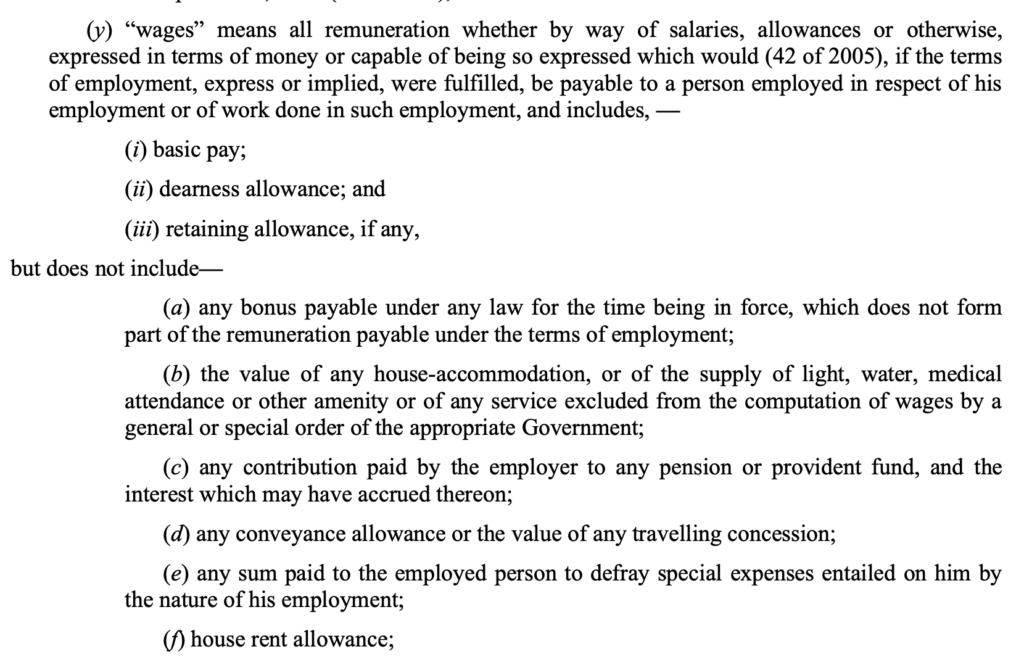
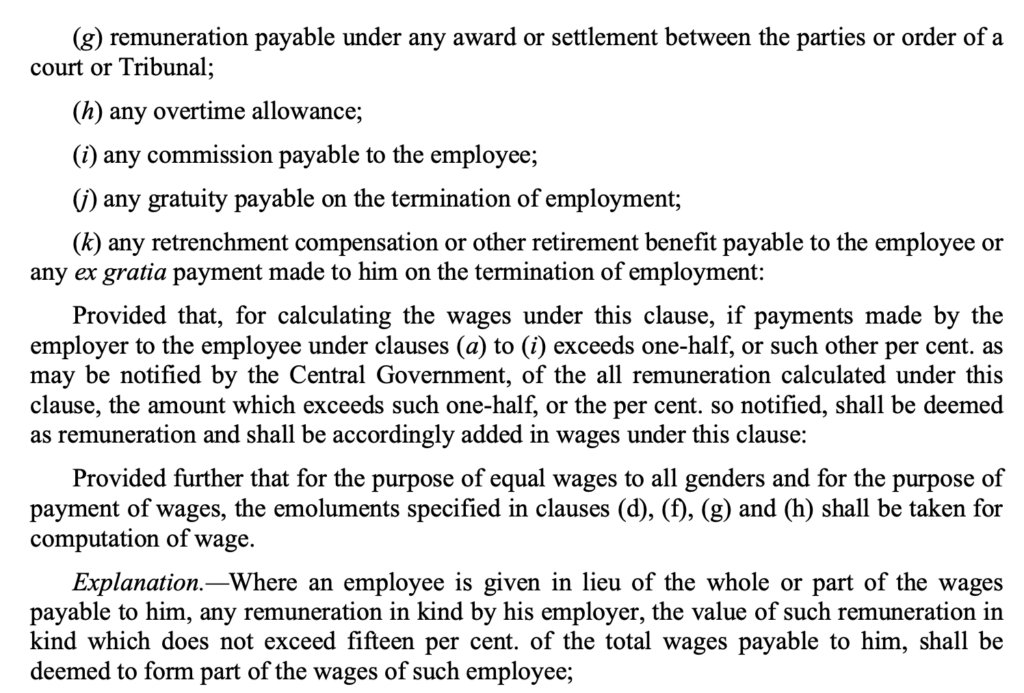
Legal reference: Section 2(y), Code on Wages, 2019.
X-ray of Definition :
Key Terms: Remuneration, Wages, Basic Pay, Allowances
1. What Does Remuneration Mean?
Remuneration is the compensation an employee is entitled to receive in return for employment or work performed, in accordance with the terms of employment.
It may include basic salary, dearness allowance, house rent allowance, special allowances, other allowances, commission or bonus, depending on the employment terms and the nature of each payment.
However, every component of remuneration does not automatically form part of wages under all Labour Codes.
The important point is that remuneration is the compensation payable for employment, whereas wages under Section 2(y) of the Code on Wages, 2019 or other labour codes is a specific legal concept with inclusions and exclusions.
2. What Does Wages Mean?
The definition expressly includes three components and excludes specified allowances and statutory benefits
| Included in Wages | Excluded from Wages |
|---|---|
| Basic pay | House rent allowance (HRA) |
| Dearness allowance (DA) | Conveyance allowance/Travelling Concession |
| Retaining allowance, if any | Overtime allowance |
| Qualifying special-expenses due to nature of employment | |
| Qualifying value of Amenities/Services by appropriate government order | |
| Commission | |
| Employer Contribution to PF/Pension | |
| Bonus | |
| Gratuity | |
| Remuneration under Settlement/Award | |
| Retrenchment Compensation/Retirement Benefit |
Note: *Illustrative summary, not an exhaustive list. The exclusions are subject to the wording of Section 2(y), including the 50% rule for specified payments. The exact wording of each exclusion matters.
For instance, the exclusion relating to special expenses is not a blanket exclusion for every payment labelled “special allowance.” The payment must be examined in light of the statutory language and its actual purpose.
Similarly, the exclusion of HRA does not mean that every rupee of HRA will necessarily remain outside the final calculation of wages.
3. Are Performance-Based Incentives, ESOPs and Reimbursements Included in Wages?
The Ministry of Labour and Employment has clarified in its FAQs on Labour Codes that the following do not form part of wages for computation under the Labour Codes:
- Performance-based incentives: Incentives linked to employee or business performance.
- Employee Stock Option Plans (ESOPs): Benefits arising under employee stock option arrangements.
- Variable components: Variable-pay components.
- Reimbursement-based payments: Payments made to reimburse employees for eligible expenses.
For example, suppose an employee receives a fixed monthly salary along with an annual performance incentive, stock options and reimbursement of official travel expenses. According to the Ministry’s clarification, these incentive, ESOP and reimbursement components are not included in wages for computation under the Labour Codes.
Important distinction: This clarification should not be interpreted as meaning that every payment described as a variable component or reimbursement is automatically excluded in every legal context. The actual nature of the payment and the applicable statutory provision must still be considered.
4 . Whether Leave Encashment be part of allowances?
As mentioned in Section 2(y) of Code on Wages, 2019, leave encashment is not a part of allowances.
5. The 50% Rule Under the Code on Wages, 2019
If the payments covered by specified exclusion clauses (a) to (i) exceed 50% of the total remuneration calculated under the definition, or another percentage notified by the Central Government, the excess amount is deemed to be remuneration and added to wages.
6. Why was the 50% Rule introduced?
To prevent an employer from reducing the statutory wage base simply by allocating a disproportionately large portion of an employee’s remuneration to specified excluded components.
For example, an employee may receive a relatively low basic salary but a substantial amount through HRA and other allowances. Even though certain components are initially excluded under Section 2(y), the excess over the prescribed threshold may have to be added back to wages.
For example, an employee may receive basic pay of ₹15,000 and DA of ₹5,000, with the remaining remuneration paid through HRA and other specified excluded components. In such a case, the final amount of wages may be higher than ₹20,000, depending on the total remuneration, the qualifying exclusions and the statutory calculation.
7. Does the 50% Rule mean that Basic Salary must be 50% of CTC?
No. The provision does not prescribe a universal requirement that basic salary must equal 50% of Cost to Company (CTC).
The statutory calculation concerns specified excluded payments in relation to total remuneration, as determined under Section 2(y). CTC may include employer contributions and other benefits that are not treated identically for this calculation.
We will examine the complete formula and numerical illustrations in Part 2: The 50% Rule Under the Code on Wages, 2019 — Explained With Examples.
8. Is Wages the Same as Basic Salary?
No. Basic pay is one component expressly included in wages, but the two terms are not interchangeable.
9. Does the Definition of Wages Apply Across All Four Labour Codes?
This single definition of wages applies across all four Labour Codes and the same definition applies uniformly for statutory calculations
10. Why Is the Definition of Wages Important?
Understanding wages is important for several reasons:
- Payroll compliance: Employers must correctly identify the relevant salary components.
- Employee awareness: Employees can better understand their payslips and statutory entitlements.
- Salary structuring: Employers should not rely solely on component labels when assessing statutory obligations.
- Labour-law calculations: Where a statutory benefit or payment depends on wages, the applicable definition and calculation provisions must be examined.
- Compliance reviews: A proper examination of remuneration helps identify potential errors in wage calculations.
11 . From which date does the definition of “wages” under the Labour Codes come into effect?
The definition of “wages” has come into effect from 21.11.2025.
Conclusion
The definition of wages under Section 2(y) of the Code on Wages, 2019 is broader than the concept of basic pay.
It expressly includes basic pay, DA and retaining allowance, while excluding specified payments subject to statutory conditions. The proviso to the definition also provides for the addition of certain excluded payments when they exceed the prescribed proportion of remuneration.
Therefore, neither basic salary nor gross salary alone necessarily represents statutory wages.
The correct approach is to examine the nature of remuneration, identify the applicable inclusions and exclusions, and apply the statutory calculation.
In Part 2, we will examine the 50% rule in detail, including step-by-step calculations and practical salary examples.
Disclaimer: This article is intended for general educational purposes. For an actual payroll or compliance decision, consult the applicable statutory provisions, rules and notifications.
Source: Labour Codes; Ministry of Labour and Employment, FAQs on Labour Codes, including the clarification on the components of wages.
Nice Content